
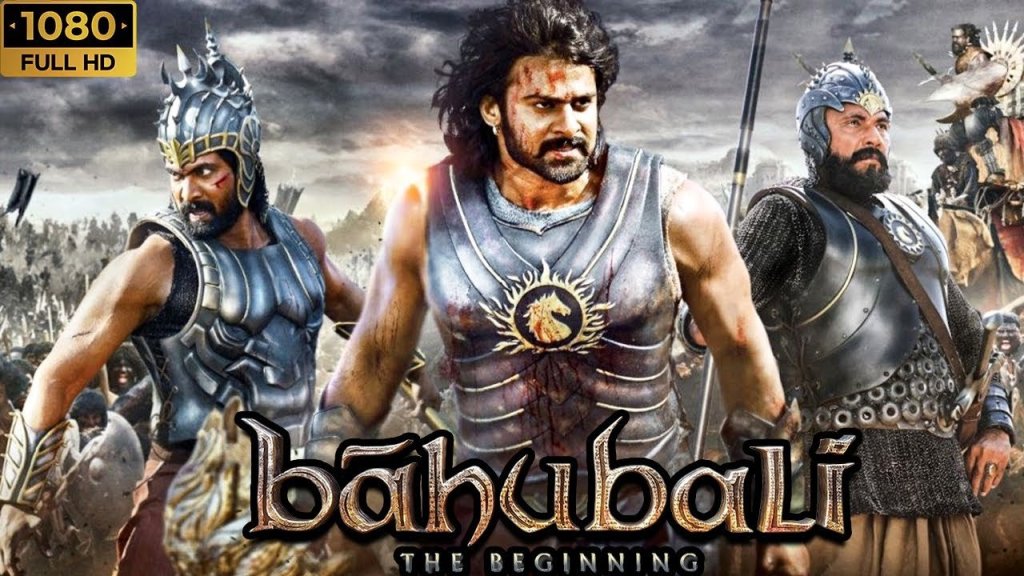
This week, I immersed myself in the vibrant world of Indian cinema, experiencing a captivating two-part film saga that took me on an unforgettable journey. The films were filled with grandiose action sequences, intense love stories, unshakable loyalty, and the sting of deep betrayal. The epic storytelling, visually stunning landscapes, and larger-than-life characters pulled me into a rich narrative that explores the complexities of family, power, and legacy. With each twist and turn, the saga built a sense of awe and anticipation, leaving a lasting impression of the heroic and dramatic moments that defined the epic tale.
Film Summarys
Baahubali: The Beginning (2015)
Baahubali: The Beginning is an epic fantasy-action film that introduces the kingdom of Mahishmati and its royal family. The story starts with Shivudu (played by Prabhas), a young man with exceptional strength and curiosity, who is raised by adoptive parents in a small village at the foot of a massive waterfall. Despite their attempts to keep him away from danger, Shivudu becomes fascinated by the towering waterfall and attempts to climb it. After a determined and perilous ascent, he reaches a mysterious new land.
In this new land, he encounters Avantika (played by Tamannaah), a skilled and dedicated warrior from a rebel group fighting against the tyranny of Bhallaladeva (played by Rana Daggubati), the ruler of Mahishmati. Shivudu is enchanted by Avantika and, after learning about her cause, decides to help her free the captured queen, Devasena (played by Anushka Shetty). Devasena has been imprisoned for years by the cruel Bhallaladeva.
The film also presents a flashback narrative that introduces Amarendra Baahubali (also played by Prabhas), Shivudu’s father, a noble and beloved warrior who once competed for the throne of Mahishmati against his cousin, Bhallaladeva. Through these flashbacks, we learn about Amarendra’s strength, wisdom, and leadership, as well as the deep rivalry between him and Bhallaladeva, fueled by jealousy and ambition.
The first installment builds tension between the past and present, showing the legacy of the Baahubali family and Shivudu’s inevitable confrontation with the current ruler of Mahishmati, Bhallaladeva. The film ends on a cliffhanger, leaving several mysteries unresolved.
Baahubali: The Conclusion (2017)
Baahubali: The Conclusion continues the epic saga, delving deeper into the events leading to the downfall of Amarendra Baahubali and the rise of Bhallaladeva as the tyrannical ruler of Mahishmati. The film picks up where the first left off, revealing crucial backstory and answering the questions raised in The Beginning.
The movie reveals the circumstances surrounding Amarendra Baahubali’s fall from power, orchestrated by Bhallaladeva and their cunning mother, Sivagami (played by Ramya Krishnan), the former queen of Mahishmati. Sivagami, once a just and powerful leader, is manipulated by Bhallaladeva into believing false accusations against Amarendra, leading to a tragic chain of events. As the story unfolds, we learn about Amarendra’s deep bond with his loyal follower Kattappa (played by Sathyaraj), whose role in the royal family’s downfall is key to the plot.
In the present timeline, Shivudu, now revealed as Mahendra Baahubali, the son of Amarendra, rises to challenge Bhallaladeva and reclaim his father’s rightful legacy. With the support of Avantika and the rebels, Mahendra Baahubali leads an uprising against Bhallaladeva’s oppressive regime. Meanwhile, Devasena’s tragic past is explored further, revealing her strength and resilience during her years of captivity.
The film culminates in a spectacular battle for the throne of Mahishmati, with grand set pieces and intense personal confrontations. Bhallaladeva’s cruel reign is brought to an end as Mahendra Baahubali fulfills his destiny as the rightful heir to the throne. The movie concludes with a sense of closure, tying up the loose ends of the royal family’s saga and providing a satisfying resolution to the epic conflict between the Baahubali and Bhallaladeva bloodlines.
5 Most Memorable Scenes
The Baahubali saga is filled with visually stunning and emotionally powerful scenes that have left a lasting impression on audiences. Here are five of the most memorable moments from the films, which showcase the grand scale, intricate storytelling, and deep emotions that define the epic:
- Shivudu’s Waterfall Climb (Baahubali: The Beginning)
One of the earliest iconic scenes is Shivudu’s (Mahendra Baahubali) ascent up the colossal waterfall. This scene is visually breathtaking, with the camera capturing the sheer scale of the mountain and the determination on Shivudu’s face. As he climbs, overcoming every obstacle with superhuman strength and agility, it becomes a metaphor for his quest to discover his true identity. The dramatic score adds to the sense of awe as he finally reaches the top, symbolizing the beginning of his journey into a much larger world.
- The Reveal of Amarendra Baahubali’s Heroism (Baahubali: The Beginning)
In a flashback, we are introduced to Amarendra Baahubali, the legendary hero, during a massive battle scene. This moment stands out for the sheer scale of the battle choreography and Amarendra’s prowess as a warrior. Riding a chariot armed with spinning blades and single-handedly taking down waves of enemies, Amarendra emerges as the embodiment of strength, intelligence, and leadership. His battle tactics and bravery in the face of overwhelming odds establish him as the hero of Mahishmati, and this scene visually conveys his larger-than-life persona.
- Kattappa’s Betrayal (Baahubali: The Conclusion)
One of the most shocking and emotionally charged moments in the saga is the revelation of Kattappa’s (the royal servant) betrayal of Amarendra Baahubali. In Baahubali: The Conclusion, this scene is the culmination of a long mystery established in the first film. The audience learns why Kattappa, who loved Amarendra like a son, was forced to kill him. The weight of this moment is felt deeply due to Kattappa’s inner turmoil and sense of loyalty. It is a turning point in the story, dramatically changing the course of events and leading to the final confrontation.
- The Coronation Scene (Baahubali: The Conclusion)
The coronation of Amarendra Baahubali as the king of Mahishmati is one of the most visually arresting and emotionally significant scenes in the saga. As the kingdom cheers for their beloved hero, Amarendra is crowned in a lavish ceremony. This moment is not just a celebration of his ascent to the throne but also a testament to his values and leadership. However, the coronation is tinged with tension, as Bhallaladeva’s jealousy and ambition simmer in the background, foreshadowing the events that will soon unfold.
- Mahendra Baahubali’s Final Battle Against Bhallaladeva (Baahubali: The Conclusion)
The climactic battle between Mahendra Baahubali and Bhallaladeva is the ultimate showdown of the saga. Set against the backdrop of Mahishmati, this epic confrontation features extraordinary action sequences, including Mahendra’s fearless and acrobatic fighting style, and Bhallaladeva’s brute strength. As the rightful heir to the throne, Mahendra seeks justice for his father’s death, while Bhallaladeva fights to maintain his tyrannical grip on the kingdom. The intensity of the battle is heightened by the emotional stakes involved, as Mahendra fights not only for himself but for his people and his family’s honor. The culmination of this battle marks the resolution of the saga, bringing a satisfying close to the story.
These five scenes encapsulate the essence of the Baahubali saga: grand visuals, heroic feats, deep emotional conflicts, and high-stakes drama that have made these films unforgettable.
Themes
The Baahubali films are rich with themes that drive the emotional core and narrative complexity of the saga. At the heart of these films are universal ideas that resonate with audiences across cultures.
- Good vs. Evil
One of the most prominent themes in Baahubali is the classic struggle between good and evil. This theme is embodied in the rivalry between Amarendra Baahubali, a symbol of righteousness, and Bhallaladeva, who represents greed, jealousy, and tyranny. Throughout both films, this battle is not just about power, but about the values of compassion, justice, and humility versus the destructive nature of unchecked ambition and cruelty.
- Loyalty and Betrayal
Loyalty plays a pivotal role, especially in relationships between rulers and their subjects, and within families. Amarendra Baahubali’s unwavering loyalty to his people and his kingdom contrasts sharply with the betrayals that occur around him, notably by those closest to him. Kattappa’s dilemma of loyalty is particularly significant, as he is torn between his duty to the royal family and his personal devotion to Baahubali. Betrayal drives much of the conflict, with family members turning on each other in their pursuit of power.
- Family and Legacy
The theme of family is central to the Baahubali saga. The films explore the impact of family dynamics on the fate of a kingdom, with Amarendra and Bhallaladeva’s rivalry reflecting deeper issues within their family. The importance of lineage and the concept of legacy are highlighted as Mahendra Baahubali must confront the responsibilities and expectations of his father’s legacy. The films delve into how the past actions of one generation shape the destiny of the next.
- Sacrifice
Sacrifice is a recurring theme in both films, portrayed in various forms—whether it’s personal sacrifice for the greater good or the sacrifices of power and happiness for the sake of loyalty and duty. Amarendra Baahubali is the epitome of a selfless leader who prioritizes his kingdom’s well-being over his own desires. Similarly, the characters around him are often faced with difficult choices that require them to put the welfare of others before their own.
- Justice and Revenge
The theme of justice is intricately tied to the notion of revenge in Baahubali. The story examines how characters seek justice for past wrongs, both through lawful means and personal vendettas. Devasena’s quest for justice after her unjust imprisonment, and Mahendra Baahubali’s drive to avenge his father’s death, show the fine line between justice and revenge. This theme adds to the emotional depth of the films, as characters must grapple with their desires for retribution while striving to restore balance and fairness to the kingdom.
- The Role of Women
Women in Baahubali play pivotal roles, often representing strength, resilience, and moral integrity. Sivagami, as the matriarch and queen, exerts significant political influence, showcasing the power women hold within the royal family. Devasena is another key figure, symbolizing unyielding resolve and standing as a fierce warrior despite her years of captivity. The films portray women not just as supporting characters but as central to the narrative, driving key decisions and influencing the course of events.
- Destiny and Fate
Throughout the films, the idea that one’s fate is inescapable is heavily explored. Mahendra Baahubali’s journey is shaped by his destiny, which is tied to his father’s legacy and the throne of Mahishmati. Despite efforts to shield him from his heritage, Mahendra is inevitably drawn to his true identity and his role in restoring justice. The concept of fate also ties into the larger narrative, as events unfold with an air of inevitability, driven by the choices of past generations.
These themes collectively create a rich tapestry of storytelling in Baahubali, blending timeless human emotions and conflicts with the grandeur of an epic fantasy setting.
Personal Review
When I first sat down to watch Baahubali, I wasn’t fully prepared for the incredible journey that awaited me. From the very beginning, I was hooked. The first film, Baahubali: The Beginning, was an exhilarating mix of epic action and deeply dramatic storytelling. The moment the cliffhanger hit at the end of the first film, I was left in complete suspense, eagerly awaiting the sequel. It was one of those moments where you just need to know what happens next, and I found myself thinking about the unresolved mysteries long after the credits rolled.
The action sequences in both films are some of the most exciting I’ve seen. Whether it’s massive battles involving thousands of warriors or a one-on-one fight between the main characters, the action is intense and visually stunning. But what makes the action even more thrilling is how much drama is built into every moment. It’s not just fighting for the sake of fighting—it’s the emotional weight behind the characters’ motivations that elevates the stakes. Every swing of a sword or heroic leap feels like it has real consequences, making the battles gripping on a deeper level.
And of course, like many Indian films, Baahubali would not be complete without its incredible music. The songs in both films are woven beautifully into the story, engaging the audience and adding an emotional layer to the narrative. From soulful ballads that express love and longing to rousing anthems that energize the action sequences, the music keeps you invested. These musical moments give the audience a chance to pause and connect with the characters on a more intimate level.
The saga’s ending in Baahubali: The Conclusion was deeply satisfying. All the loose ends from the first film were tied up, and the resolution was everything I hoped it would be. The story comes full circle, and the final confrontation between Mahendra Baahubali and Bhallaladeva is nothing short of epic. It’s not just about who wins, but about the triumph of justice, love, and loyalty over betrayal and cruelty. The emotional weight of the journey, combined with the action-packed finale, left me feeling both exhilarated and satisfied.
I highly recommend Baahubali for anyone who loves dramatic action films. It’s not just about the battles and sword fights—it’s a story filled with heart, sweet love stories, and intense tests of loyalty and betrayal. Whether you’re in it for the action, the drama, or the music, this saga delivers on every front. It’s an epic in every sense of the word, and one of those rare films that truly stays with you long after you’ve finished watching.
Give the saga a view and let me know what you think!
For next week’s film and tv drama summary and this’s week’s song, check out my most recent post in TV Dramas.
Check out my social media sites!
Facebook: MM Exploration
Instagram: meganmay235
X (Twitter): MeganMay235
 MM Exploration
Leave a comment